Native API
This page describes EvoDAG’s own classes: EvoDAGE (the ensemble), EvoDAG.model.EvoDAG (a single model), the search engine RGP and the Model and Ensemble objects that their fits return. They do not need scikit-learn. The scikit-learn classes of the Python page are the usual way to use EvoDAG; they are built on the same code and fit the same models.
Use the native API when you:
- work with the models that the command line stores, which are
ModelandEnsembleobjects; - need what only
EvoDAGEoffers: atime_limitfor the whole ensemble,tmpdirto resume an interrupted fit, atest_setevaluated along the evolution, ormax_training_size; - have code that already uses these classes.
The two forms are equivalent. With the same parameters, seed and labels they fit the same models, and the regression predictions and the decision_function (the median over the members) are identical. The one difference is the predict of the classification ensemble: EvoDAGE returns the class chosen by most members, whereas EnsembleClassifier returns the class with the largest median decision_function (the sign of it with two classes), so that predict, decision_function and predict_proba agree, as scikit-learn expects. The two rules coincide on most examples, not on all of them.
| Native API | scikit-learn classes |
|---|---|
EvoDAGE(n_estimators=n, seed=s, **kw) |
EnsembleClassifier(EvoDAGClassifier(**kw), n_estimators=n, random_state=s) |
EvoDAGE(n_estimators=n, seed=s, classifier=False, **kw) |
EnsembleRegressor(EvoDAGRegressor(**kw), n_estimators=n, random_state=s) |
EvoDAG.model.EvoDAG(seed=s, **kw) |
EvoDAGClassifier(random_state=s, **kw) |
EvoDAG.model.EvoDAG(seed=s, classifier=False, **kw) |
EvoDAGRegressor(random_state=s, **kw) |
In the scikit-learn classes the keywords kw that are not popsize, early_stopping_rounds or time_limit go in params={...}, and the labels may be anything (the native classes want numbers).
The Python blocks on this page share state: each one builds on the variables of the previous one, so you can paste the whole page into a script.
Which class do I use?
There are three entry points, and the name EvoDAG is used by two of them.
| Import | What it is |
|---|---|
from EvoDAG import EvoDAGE |
the ensemble with a fit / predict interface |
from EvoDAG.model import EvoDAG |
a single model with the same interface |
from EvoDAG import EvoDAG (also RGP, RootGP) |
the search engine that runs one evolution; you get the fitted model with .model() |
Model and Ensemble (what the fits return) are also importable from the top-level package: from EvoDAG import Model, Ensemble.
Data
X is a two-dimensional array with one row per example, or anything NumPy can turn into one (a list of lists, for instance). For classification y holds the class of each example as numbers, and the predictions are given back in the same numbers; they need not be consecutive. Strings as labels are not accepted by these classes (the command line maps them to numbers for you, and the classes of the Python page accept them). For regression y holds the real targets.
import numpy as np

rng = np.random.RandomState(0)
X = rng.randn(200, 5)
# three classes, labelled 1, 5 and 9
y = (X[:, 0] + X[:, 1] ** 2 > 1).astype(int) + (X[:, 2] > 1.0)
y = np.array([1, 5, 9])[y]
Classification with an ensemble
EvoDAGE trains n_estimators independent EvoDAG runs. Each run gets its own seed (seed, seed + 1, …), and therefore its own random split of the training data into the part used to evolve and the validation part used to stop (see How it works). n_jobs is the number of processes used to train the members and to evaluate them later.
from EvoDAG import EvoDAGE

ensemble = EvoDAGE(n_estimators=5, n_jobs=1, popsize=100,
                   early_stopping_rounds=100, seed=0).fit(X, y)
hy = ensemble.predict(X)
print("accuracy:", (hy == y).mean())
Any keyword that is not an argument of EvoDAGE is a parameter of the evolution (here popsize and early_stopping_rounds); all of them are listed in Parameters.
fit returns the fitted EvoDAG.Ensemble, which has these methods:
| Method | Returns |
|---|---|
predict(X) |
the class of each row: the class chosen by most members |
predict_proba(X) |
one row per example, one column per class: the fraction of members that voted for each class |
decision_function(X) |
the median over the members of the raw outputs, one column per class |
raw_decision_function(X) |
the raw outputs of every member side by side, with n_estimators * n_classes columns |
models |
the list of Model objects, one per member |
The columns follow the sorted class labels, which are np.unique(y).
proba = ensemble.predict_proba(X)
print(proba.shape, proba.sum(axis=1)[:3])

scores = ensemble.decision_function(X)
print(scores.shape)

raw = ensemble.raw_decision_function(X)
print(raw.shape)
print(len(ensemble.models), "members")
For classification a model has one output per class: the problem is solved one class against the others, and predict picks the class with the largest output. When the last node of a model is a Naive Bayes or a Nearest Centroid node its outputs are squashed into the interval from -1 to 1 before they are returned; for any other kind of node they are the raw values.
Classification with a single model
EvoDAG.model.EvoDAG fits one run. It takes the same keywords as the ensemble, without n_estimators, n_jobs and tmpdir. After fit the fitted model is in the model attribute.
from EvoDAG.model import EvoDAG as SingleEvoDAG

single = SingleEvoDAG(popsize=100, early_stopping_rounds=100, seed=0).fit(X, y)
print("accuracy:", (single.predict(X) == y).mean())

model = single.model
print("nodes:", model.size, "height:", model.height)
print("validation fitness:", model.fitness_vs)
decision_function of a single model returns a list with one array per class, instead of one two-dimensional array. model.fitness_vs is the fitness on the validation part, and it is the negative of the error: zero is perfect and lower values are worse.
Regression
Pass classifier=False. The defaults for regression come from a different file, default_parameters_r.json, and predict returns the real values. That file has the ordinary selections (a tournament on fitness for the arguments and a negative tournament for the individual that leaves), not the random selection that is the default of classification.
yr = 2 * X[:, 0] + X[:, 1] ** 2 + 0.1 * rng.randn(200)

regressor = EvoDAGE(n_estimators=5, classifier=False, popsize=100,
                    early_stopping_rounds=100, seed=0).fit(X, yr)
hr = regressor.predict(X)
print("correlation:", np.corrcoef(hr, yr)[0, 1])
In regression the ensemble prediction is the median of the members’ predictions. A regression with several targets at once is possible: pass multiple_outputs=True and a list with one array per target as y; predict then returns one column per target.
Choosing the function set and other parameters
The functions that EvoDAG may use to build an individual are parameters, named after the function. A boolean switches the function on or off; an integer sets how many arguments it takes, and 0 removes it. Everything else is an ordinary keyword.
tuned = EvoDAGE(n_estimators=3, popsize=100, early_stopping_rounds=100,
                Mul=0, Sin=False, Add=10, tournament_size=3,
                seed=0).fit(X, y)
print((tuned.predict(X) == y).mean())
You can also start from a JSON file of your own with params_fname; the format is described in Parameters. Keywords given in the call override what the file says.
Looking inside a model
A fitted Model is a list of nodes stored in evaluation order. It can tell how big it is, which input variables it ended up using, and it can write itself in the dot language of Graphviz.
import io

print("inputs used (variable: times):", dict(model.inputs()))

dot = io.StringIO()
model.graphviz(dot)
print(dot.getvalue().splitlines()[0])
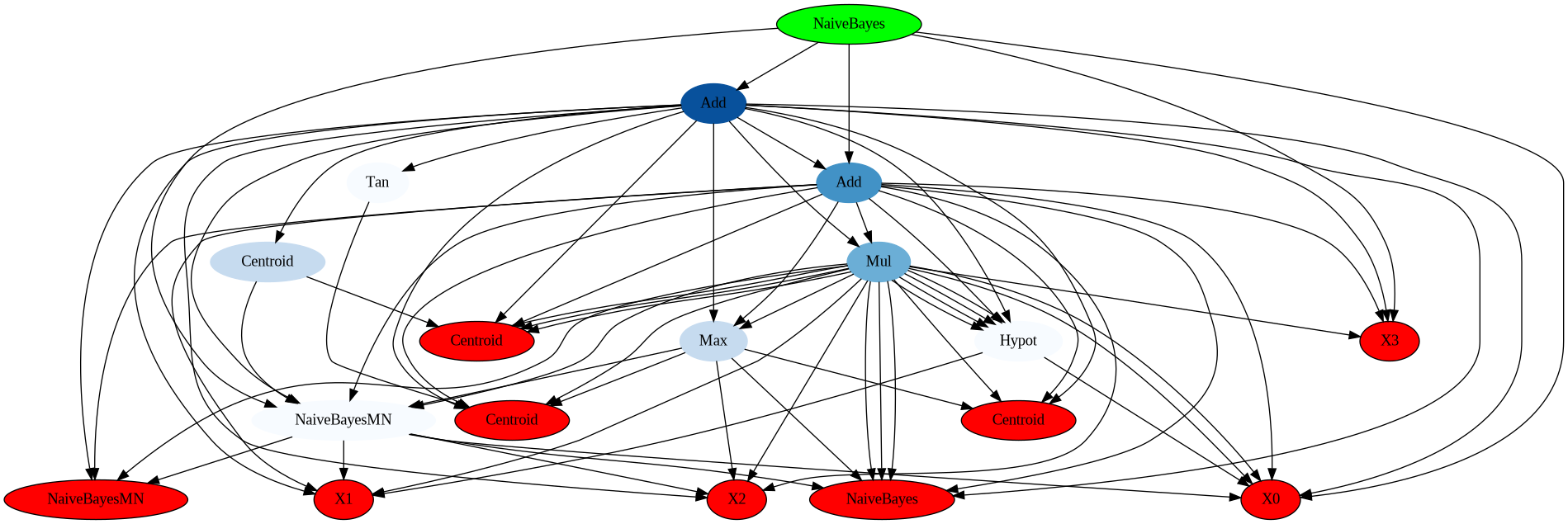
model.graphviz("model.dot") writes the same text to a file, and model.graphviz(fpt, terminals=False) leaves the input variables out. With Graphviz installed, dot -Tsvg model.dot -o model.svg draws it. In the picture below the node at the top (green) is the output; the red nodes are the ones at height zero, which are the inputs and the functions applied directly to them; the blue ones are internal nodes, darker the higher they are.
For an ensemble, ensemble.graphviz("directory") writes one file per member into that directory.
Saving and loading
Models and ensembles are plain Python objects and can be pickled. The command line tools store their models with pickle inside a gzip file.
import pickle

blob = pickle.dumps(ensemble)
restored = pickle.loads(blob)
print((restored.predict(X) == hy).all())
Running one evolution yourself
The search engine is what the classes above are built on. RGP.init reads the default parameters, fit runs the evolution and model() returns the fitted model. You can also reach the population it evolved.
from EvoDAG import RGP

engine = RGP.init(popsize=100, early_stopping_rounds=100, seed=0)
engine.fit(X, y)
best = engine.model()
print(type(best).__name__, "predictions:", best.predict(X)[:5])
print("individuals created:", len(engine.population.hist))
engine.model() returns the early stopping individual: the one with the best fitness on the validation part. engine.model(v) returns the model of any individual v found in engine.population.hist.